If you own a home in Ozaukee, Washington, or Sheboygan County, there’s a good chance you have an ash tree in your yard, or had one until recently. For decades, ash was one of the most planted shade trees in Wisconsin. It grew fast, handled clay soil, and lined street after street.
Then emerald ash borer showed up. Wisconsin’s first confirmed case was found in 2008 near Newburg, in Ozaukee County — just down the road from our home base in Belgium. Since then, the beetle has spread to every county in the state, and it has killed ash trees by the thousands.
This guide explains how to tell if a tree is an ash, what emerald ash borer damage looks like, why dead ash trees are so risky, and how to choose between protecting, removing, or replacing your ash trees.
What Emerald Ash Borer Is and Why It Matters Here
Emerald ash borer (often called EAB) is a small, shiny green beetle from Asia. The adult is only about half an inch long. It isn’t the adult that kills trees — it’s the larvae.
Female beetles lay eggs in cracks in ash bark. The larvae hatch, chew into the tree, and feed on the thin layer of living wood just under the bark. That layer is how the tree moves water and food between its roots and leaves. As the larvae tunnel in winding S-shaped paths, they cut off that supply bit by bit. The tree starves from the top down.
Because the damage is under the bark, most homeowners don’t notice anything for the first few years.
Ash borer has been in southeast Wisconsin longer than anywhere else in the state. Most ash still standing here are either protected trees or trees that are declining.
How to Tell If Your Tree Is an Ash
Before you worry about ash borer, make sure the tree is actually an ash. We get plenty of calls about “ash trees” that turn out to be something else.
Ash Tree Features to Look For
- Opposite branching. Branches and buds grow in pairs, directly across from each other on the twig. This is the biggest clue.
- Compound leaves. Each leaf is made of 5 to 11 smaller leaflets on one stem.
- Diamond-pattern bark. On older ash, the bark has tight, crisscrossing ridges that form a diamond or net pattern.
- Paddle-shaped seeds. In fall and winter, ash trees often hang clusters of narrow, single-wing seeds.
A handy memory trick is “MAD Horse”: Maple, Ash, Dogwood, and Horse chestnut (buckeye) are the common trees with opposite branching. If your tree has opposite branches and compound leaves, it’s very likely an ash.
Trees People Mistake for Ash
| Tree | Branching | Leaves | How to Tell It Apart |
|---|---|---|---|
| Ash (white, green, black) | Opposite | 5–11 leaflets | Diamond-pattern bark, paddle-shaped seeds |
| Boxelder | Opposite | Usually 3–5 leaflets | Green or purple twigs, seeds in V-shaped pairs like a maple |
| Mountain ash | Alternate | 11–17 small, toothed leaflets | Clusters of orange-red berries — not a true ash, not at risk |
| Black walnut | Alternate | 15–23 leaflets | Round green nuts, dark deeply furrowed bark |
| Hickory | Alternate | 5–7 large leaflets | Nuts in thick husks; shagbark peels in long strips |
| Kentucky coffeetree | Alternate | Huge, twice-divided leaves | Thick leathery seed pods in winter |
If you’re still not sure, snap a photo of a twig with leaves attached and a close-up of the bark. Our arborist can usually identify it from a picture.
Signs of Emerald Ash Borer in Your Yard
The Wisconsin DNR suggests looking for at least two signs before deciding a tree has ash borer, since some symptoms can come from other problems. Here’s what to check, from the top of the tree down.
Thinning at the Top of the Canopy
The first thing most people notice is a thin crown. Leaves at the very top look sparse compared to the rest of the tree, or compared to healthy ash nearby. Over the next few seasons, top branches die and the thin area spreads downward.
Woodpecker Flecking on the Bark
Woodpeckers love ash borer larvae. When they peck through the outer bark to reach them, they leave light-colored patches where the darker bark has been flaked away. People call this “flecking” or “blonding.” It often shows up high on the trunk and big limbs first, and it’s easiest to see in winter.
D-Shaped Exit Holes
When adult beetles chew their way out of the tree in late spring and summer, they leave small holes shaped like a capital letter D. They’re about 1/8 inch across — smaller than a pencil eraser — with one flat side. These are the most specific sign of ash borer, but they’re small and often high up, so they can be hard to spot.
Vertical Bark Splits and S-Shaped Tunnels
As the tree tries to heal over the feeding tunnels, the bark can crack open in short vertical splits. If you peel back a loose piece of bark, you may see winding S-shaped tunnels packed with fine sawdust. That pattern is a strong sign of ash borer.
Sprouts on the Trunk and Base
A stressed tree tries to survive by pushing out new shoots wherever it can. Clumps of leafy sprouts growing straight out of the lower trunk or around the base — called epicormic sprouts — often show up below the part of the tree where larvae are feeding.
How Fast an Infested Ash Declines
Every tree is different, but most infested ash follow a similar path. The DNR notes that trees usually show thinning at the top within one to three years of being infested, followed by branch death and then tree death.
| Stage | What You’ll See | What It Means |
|---|---|---|
| Early | Tree looks mostly normal; maybe a little woodpecker activity | Larvae are feeding, but the tree is still strong — the best time to protect it |
| Thinning | Sparse leaves at the top, some flecking, a few dead twigs | Damage is spreading; protection may still work if thinning is under about half the canopy |
| Heavy decline | Dead top branches, bark splits, sprouts on the trunk | Too late for treatment in most cases — time to plan removal |
| Dead | No leaves, bark falling off, limbs dropping | Brittle and hazardous — remove it before it fails |
The key takeaway: the window to save an ash is early, and the window to remove it safely closes fast once it dies.
Why Dead Ash Trees Are So Dangerous
Most dead trees get weaker slowly. Ash killed by emerald ash borer is different. Once the tree dies, the wood dries out and turns brittle surprisingly fast. We’ve seen big limbs snap off dead ash on calm, sunny days, and whole trees break near the base without warning.
That’s a risk for your house, your car, and anyone walking underneath. It’s also a real hazard for the crew taking it down:
- Climbers can’t trust the wood. A normal removal often starts with a climber roped into the tree. A brittle dead ash may not safely hold a climber’s weight or the force of lowering cut pieces with ropes.
- Limbs break in unexpected places. Dead ash can snap anywhere, not just where it was cut.
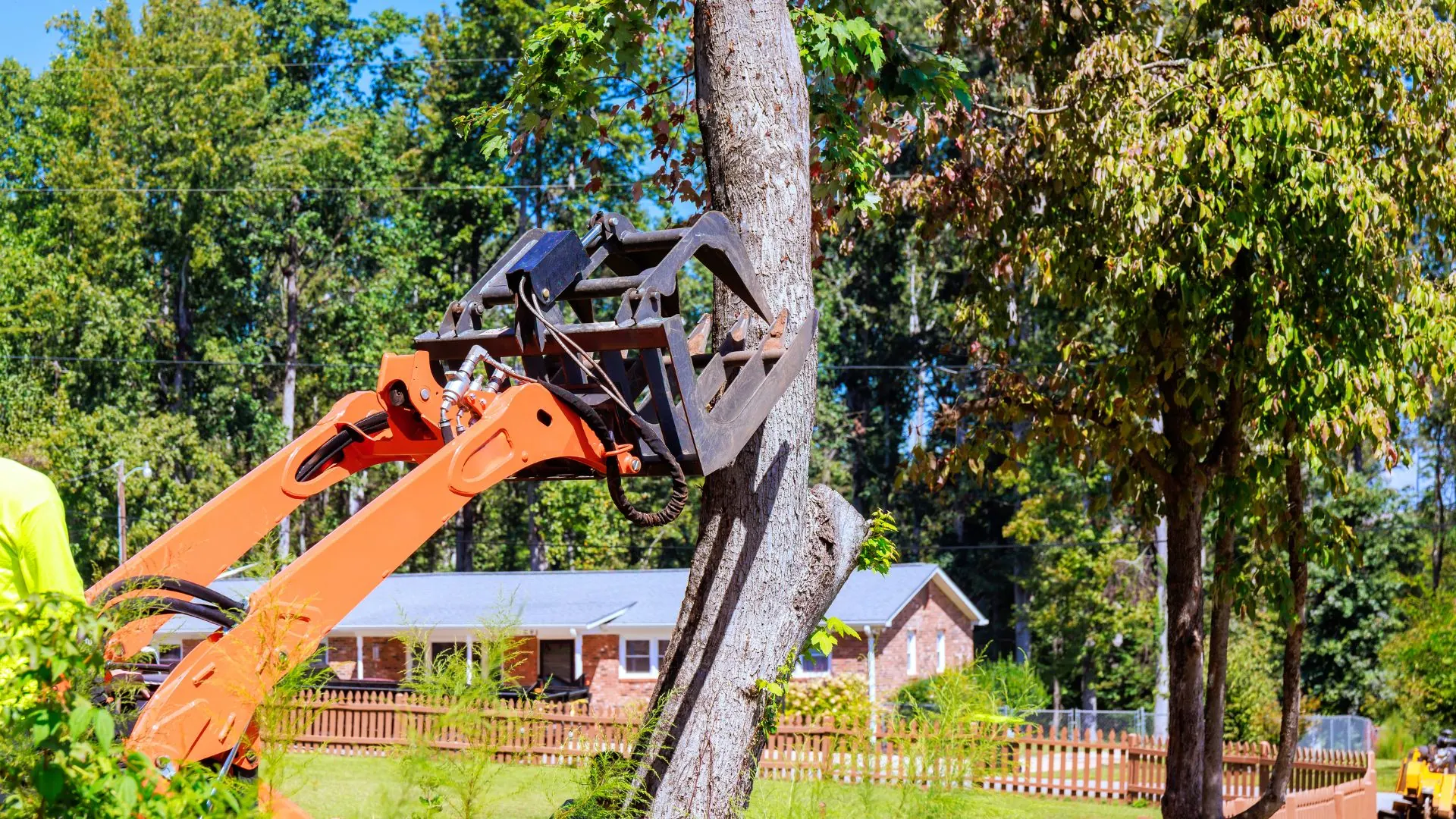
- The job needs more equipment. To keep people out of the tree, we often use an aerial lift, a loader, or other machines to take a dead ash down in controlled pieces. That can mean more time and more cost than taking down the same tree while it was still alive.
This is why we tell homeowners the same thing over and over: if an ash is dying and it isn’t worth saving, take it down sooner rather than later. It will never be safer or cheaper to remove than it is right now. Our storm-readiness checklist explains why dead ash are some of the first trees to fail in wind and ice, too.
Your Three Options for an Ash Tree
When you have an ash in your yard, you really have three choices. Many homeowners end up using more than one — protecting their best tree, removing the weak ones, and planting new trees to fill the gaps.
Option 1: Protect a Healthy, Valuable Ash
Insecticide treatments can protect an ash tree from emerald ash borer, and they work well on the right tree. UW–Madison Extension says treatments are much more effective on trees with less than 50% canopy thinning. Trees worse off than that should usually be removed.
A tree is a good candidate for protection when it is:
- Healthy, with a full or mostly full crown
- Well shaped and in a good spot, not crowding the house or power lines
- Valuable to you for shade, looks, or privacy
- Something you’re willing to keep treating on a schedule for as long as you own it
Protection is not a one-time fix. Most products need to be reapplied every year or every few years for the life of the tree.
An honest note from us: Alpha Tree Service does not apply insecticide treatments. Treating trees for hire in Wisconsin requires pesticide applicator certification through DATCP. If your ash is worth saving, we’ll tell you so and point you toward someone who is certified to apply the treatment. You can also read UW–Madison Extension’s guide, Is My Ash Tree Worth Treating?, to help you decide.
Homeowner soil-drench products sold at garden stores can protect smaller ash, but Extension research shows they struggle on big trees. For a large ash, talk to a professional applicator.
Option 2: Remove the Ash Before It Gets Worse
If your ash has heavy thinning, dead limbs, bark splits, or sprouts along the trunk, removal is almost always the right call. The same goes for ash that are poorly placed or not worth treating year after year.
Taking an ash down while it’s still alive, or just starting to decline, is safer and usually simpler than waiting until it’s dead and brittle. Our tree removal crew takes down ash of every size, including trees tight against houses, garages, and fences. After the tree is down, stump grinding clears the way for a new tree or a patch of lawn.
Option 3: Replant With a Mix of Species
Emerald ash borer taught Wisconsin a hard lesson. When whole streets were planted with one kind of tree, one pest wiped them out. The fix is simple: plant a mix.
Many foresters follow a rule of thumb to keep any one species to a small share of the trees in an area. In your own yard, that just means choosing a different kind of tree for each spot instead of three of the same. Good choices for southeast Wisconsin include:
- Swamp white oak — handles clay and wet spots
- Kentucky coffeetree — tough, with few pest problems
- Hackberry — handles wind, drought, and poor soil
- Basswood (American linden) — a native shade tree that grows well here
- Disease-resistant elm varieties — bred to stand up to Dutch elm disease
- Serviceberry or ironwood — smaller trees for tight spots and under power lines
For more ideas, read our post on the best trees to plant in Wisconsin yards. Plant a new tree near where the old ash stood, but not in the exact same hole unless the stump has been ground out.
A Quick Ash Decision Checklist
Walk out to your ash and go through this list:
- Confirmed true ash — opposite branches, compound leaves
- Canopy under half thin — or is it worse?
- Two or more EAB signs — flecking, D-shaped holes, splits, or sprouts
- Distance to targets — house, garage, driveway, fence, neighbor’s roof
- Tree’s value to you — shade, privacy, looks
- Long-term treatment budget — repeat applications for years
- Replacement tree plan — what goes in its place
If the tree is healthy, valuable, and you’re ready for ongoing treatment, protection may make sense. If the canopy is more than half gone, the tree is dead, or it could land on something important, plan removal.
Don’t Move Ash Firewood
Emerald ash borer didn’t fly across the state on its own. It moved mostly in firewood. Larvae can survive inside cut logs, then come out in a new place and start a new infestation.
Wisconsin lifted its state emerald ash borer quarantine in 2023, since the beetle is now found in all 72 counties. But firewood still spreads ash borer and many other pests and diseases, so a few rules still matter:
- Burn it where you cut it. Wood from your own ash is fine to burn at home or nearby.
- Don’t bring outside firewood onto state land. The Wisconsin DNR doesn’t allow firewood from more than 10 miles away on state properties unless it’s certified by DATCP. That includes places near us like Harrington Beach State Park and the Kettle Moraine State Forest.
- Buy local or certified wood when you go camping or up north.
- Chip it instead. Ash branches run through a chipper make great mulch for your garden beds.
When we take down an ash, we can leave the wood cut to length for your own fire pit or haul it away. Chipped branches can go back into your landscaping.
How Alpha Helps With Ash Trees Around Belgium
We’ve been dealing with emerald ash borer damage since we started Alpha Tree Service in 2020, from Belgium and Port Washington to Grafton, Cedarburg, and West Bend. Ozaukee County was ground zero for this beetle in Wisconsin, and our crew has taken down a lot of ash in the years since.
Here’s what we can do for your ash trees:
- Look them over. Our ISA Certified Arborist will check each ash, look for signs of ash borer, and tell you straight whether it looks healthy, declining, or dead. Learn more on our tree health care page.
- Tell you honestly if treatment makes sense. If your tree is a good candidate, we’ll say so and point you to a certified applicator. We won’t talk you into removing a tree that can be saved.
- Remove dead and dying ash safely. We bring the right equipment for brittle wood, protect your lawn, and clean up when we’re done.
- Grind the stump and help you replant. We’ll grind the stump and suggest trees that fit the spot.
If you’re comparing crews for ash removal, our hiring checklist walks you through the questions to ask any tree company, including ours. And if you live near the lake or along the Milwaukee River, our Ozaukee County tree service page covers the local problems we see most often.
Emerald ash borer isn’t going away. But with a clear plan — protect the best, remove the worst, and replant with a mix — your yard can come out of it safer than before.